
Commitment = Your Finished Memoir
By Grant Faulkner
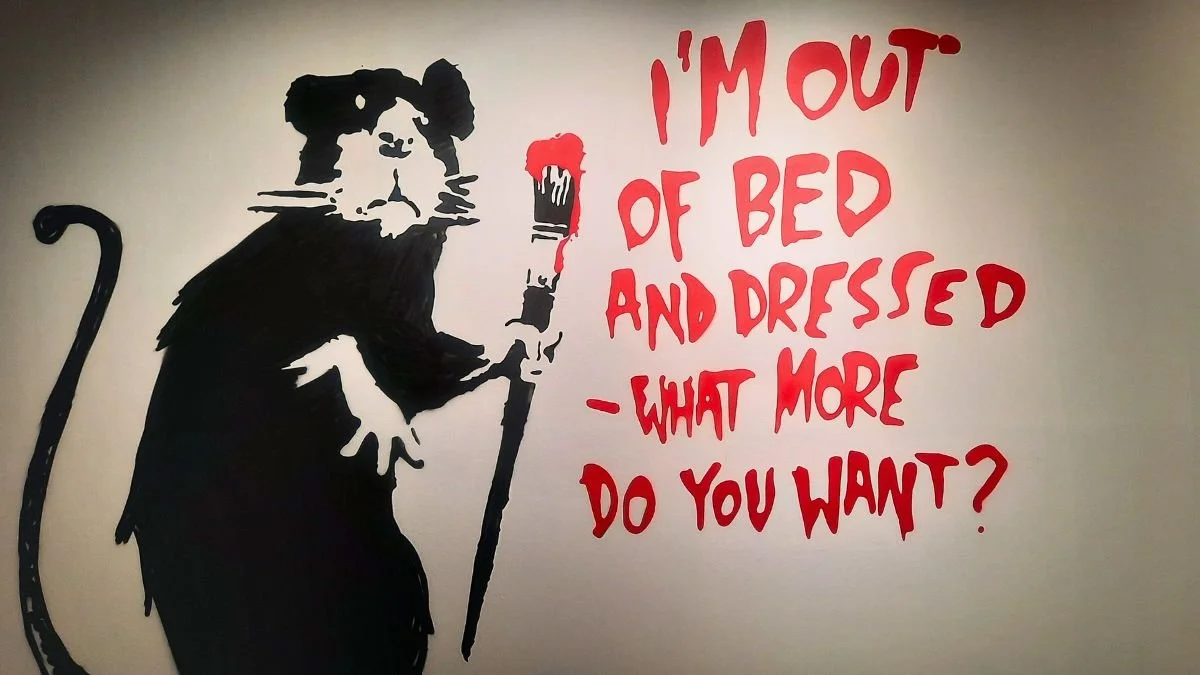
To answer the question from Banksy’s graffiti above: I want you to write your story!
I want you to take part in JanYourStory and commit to writing 500 words for 31 days in January.
Commit is the key word in that sentence. Books require one thing beyond inspiration, great ideas, and wonderful writing: commitment.
Commitment is actually part of the recipe for inspiration, great ideas, and wonderful writing, but it doesn’t necessarily come easily.
Writing a book has been compared to running a marathon, climbing a mountain, or even going to war. And it can feel like all those things in one.
So, one crucial task of finishing your memoir is to train for endurance and believe that the very act of finishing is magic itself because the stamina it takes to finish a memoir is the same kind it takes to make a memoir good.
“I’ve said it’s hard,” said Mary Karr. “Here’s how hard: everybody I know who wades deep enough into memory’s waters drowns a little.”
Preparing your mind for the long haul
Let’s face it, writing a memoir tends to be more mentally, emotionally, and physically challenging than other genres.
It’s tough to keep moving—through the memories, but also through the words. The slow march of daily progress can abrade against the zeal that fuels the early creative stages, and the day-after-dayness of it all often exhausts writers’ attention spans.
It’s critical to remember that training for a marathon isn’t just about physical training; it’s also about preparing your mind to run for such a long time.
It took Laura Davis 10 years to write her memoir, The Burning Light of Two Stars, about caring for her mother at the end of her life.
Frank McCourt described the writing process for his memoir, Angela’s Ashes, as taking “two years and all my life to write it.” He attempted a fictional version in the 1960s but abandoned it. He retired from teaching in 1988 and concentrated on writing, and Angela’s Ashes was published eight years later in 1996.
You need to prepare your mind for the grind no matter what length or how ambitious your memoir is. Think of the many days that a marathon runner’s legs are stiff with fatigue, when every stride is the definition of slogging along.
You’re going to wake up some days and stare at your memoir and have to proceed with a similar slogging stride—through the terrible, the mediocre, the not-quite-there, the I-don’t-think-I-can-get-it-there, the I’m-not-a-writer, and the definitive “I quit.”
Yes, you’re going to want to stop. Perhaps often. But don’t worry. Just start again. And double down on your grit.
The grit factor
Every memoir requires a simple four-letter word that is as important as imagination itself: grit. Grit is that extra something that separates the most successful people from the rest. Research has shown that grit is even more important for success than intelligence or talent.
Grit is a super-heroic elixir. It’s a persistence that’s fortified with passion, optimism, and hope—a combination that coalesces into a steely and unwavering purpose that keeps us moving with consistent effort toward our goal even when we struggle, falter, or outright fail.
Grit is sticking with your future, day in and day out.
Grit equips us with a shield that deflects naysayers and doubts. It’s an energy drink, a pep talk, a sprinkle of fairy dust, and a compass all in one.
“Grit is sticking with your future, day in and day out, and not just for the week, not just for the month, but years,” said Angela Duckworth, a psychological researcher who focuses on studying grit and has given a popular TED talk on it.
Developing grit leads to another writing superpower: resilience. Resilience allows you to adapt in the face of adversity and push yourself through obstacles.
So often we think that mental toughness is about how we respond to extreme situations—bouncing back after getting fired or divorced or surviving a traumatic experience. There’s no doubt that extreme situations test us, but the everyday work of writing a memoir requires you to approach your mental toughness like a muscle that needs to be worked to develop. If you haven’t pushed yourself in hundreds of small ways, you’ll wilt when things get difficult.
“Someday” is never today …
That’s when people often talk themselves out of committing. It’s easy to make an excuse to not write your memoir today—but to write it in that more idyllic land of someday—because you just don’t have the time now.
“‘I don’t have time’ means ‘It’s not a priority.’ We always have time for what matters to us,” said time management guru Laura Vanderkam (who will be featured on the Memoir Nation podcast in December).
In fact, Vanderkam has an interesting exercise. Instead of saying, “I don’t have time,” she says we should say “It’s not a priority” as a way to think about what’s truly a priority in our lives. So instead of saying “I don’t have time to write my story now,” say, “My story isn’t a priority.”
Is writing your story a priority? Then commit to it! Make sure your priorities guide your time (which is another word for your life).
The time limitation of the goal and deadline of JanYourStory can be good for your writing. One’s imagination doesn’t necessarily flourish in the luxury of total freedom someday. One of the many paradoxes of human creativity is that it seems to benefit from the pressures and boundaries of our daily lives.
A time restriction of writing an audacious number of words in 30 days takes away choices that can cause one to dally and maybe not start at all. Constraints also keep perfectionist notions from eating away at you: You dive in and just start writing because you have to.
“The ticking clock is our friend if it gets us moving with urgency and passion,” Twyla Tharp says.
The “choice architecture” of commitment
One way to fortify your commitment is to announce your goals. When you tell your friends and family about your goals and join the larger Memoir Nation community in cheering one another on, you’re reinforcing your commitment. When your next-door neighbor asks, “What’s your word count?”, you won’t want to disappoint them—or yourself.
It’s all about “choice architecture”—designing your life and goals around the things you rationally want to achieve instead of sinking into the powerful claws of more impulsive needs.
Over time, your discipline will become a habit, a necessity, as instinctual as brewing that caffeine upon waking.
All of these words—commitment, grit, resilience, stamina, endurance—they all add up to inspiration. No one has ever finished a memoir by sitting around and waiting for inspiration. Inspiration is conjured by your work.
For a writer, life hasn’t really been lived until one’s stories find their way onto the page, so don’t doubt yourself. The signature of your singular self is formed by the work you put into your story.
Therein the magic lies. And the commitment.
If you want to commit to your memoir, join JanYourStory—and write 500 words per day every day in January!
Are you already signed up? Thank you! And spread the word by sharing this meme. Invite your friends. The more people who participate, the more fun we’ll all have.
Thanks for sharing with an author or writer in your life . . .